New publication: Retranslating the Qurʾān
Marija and I wrote a thing about Slovene translations of the Qurʾān (Zlatnar Moe and Moe 2024). This is my first publication in Translation Studies, and my first international publication co-authored with my better half, who unlike me is a translation scholar. It’s out in a new book on Retranslating the Bible and the Qur’an (Boulogne, de Lang, and Verheyden 2024). Re-translating sacred texts, after a translation has already gained authority, can be an even more fraught venture than translating them in the first place. If you’re still reading this, chances are you’re the kind of person who finds this kind of stuff interesting, and you’re in luck: You can download the whole volume as an open access e-book for free, or buy a print copy.
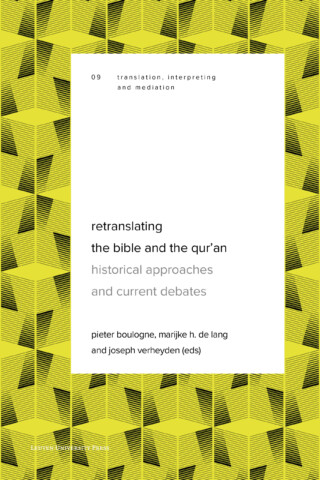
Figure 1: Cover of Retranslating the Bible and the Qur’an.
As the editors say:
Marija Zlatnar Moe and Christian Moe discuss four recent retranslations of the Qur’an in Slovenia and the strategies used for balancing between different regional languages and the mixed readership of Muslims and non-Muslims. They explore the reasons behind each translation, their translation policies, such as the choice for a domesticating or foreignizing approach, and the translation’s reception by the intended readerships. The authors suggest that in the presence of an immigrant Muslim community with its own translation history, both the definition of retranslation and the meaning of source- and target-oriented state of retranslation are complicated by religious and linguistic center–periphery relations.
(Boulogne, de Lang, and Verheyden 2024, Introduction)
Between 2003 and 2014, the tiny Slovenian literary market saw the publication of three complete translations plus a volume of selected verses, where before there had only been scattered translations of a few suras.
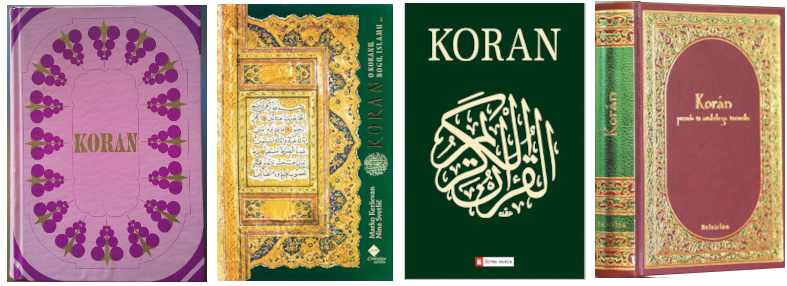
Figure 2: Four Slovene Qurʾān translations. Left to right: Jelinčič (2003); Kerševan and Jeglič (2004, selected verses); Majaron (2004); Alhady and Alhady (2014).
And yet, it would be a stretch to say that any of these books has established itself as the Slovene Qurʾān. Only one was a complete direct translation from Arabic, and though it was a good decade in the making and backed by state funding, it got a bumpy reception by both intended target audiences – Muslim and non-Muslim. The critics cared passionately about issues that were literally about the size of a gnat.1 Though the Muslims had some concerns about orthodoxy along the way, the biggest sticking points on all sides were about orthography, such as the spelling of “Allah” with one or two l’s. Corporal punishment for the publisher was suggested by one of the more fanatical adherents of … Slovene spelling.
We suggest that this reception has to do with such things as the role of language and religion as national identity markers; the prior history of (re-)translations of the Qurʾān into Bosnian, which is the mother tongue of most of Slovenia’s Muslims and is closely related to Slovene; and the past and present relations that made both audiences insist that their own tradition should be central to the project. In that sense, our take is theoretically informed by Marija’s and her colleagues’ work on center–periphery relations in the translation system (Zlatnar Moe, Žigon, and Mikolič Južnič 2019), but here we also take the regional religious system into account. Additionally, there were specific developments that left the Muslim leadership lacking ownership to the project they had been expected to endorse.
Our outlook is also informed by my personal observations and reflections, as I took part in an advisory group for one of the translations for a while, but our analysis is anchored in the texts, the public debate, and broader socio-cultural considerations. We do not assess my role, which had little or no impact on the translation as it was eventually published; suffice it to say that, in hindsight, I might have shown more foresight.
The book stems from an on-line conference organized by the editors in 2022.2 It’s been a real pleasure to work with Pieter and his colleagues, who handled the whole process from call for papers to published volume very smoothly and professionally.
References
Footnotes:
Specifically, about whether God in 2:26 does not disdain to make a parable about something smaller than a gnat, or something bigger.
It was originally supposed to take place physically in Leuven in March 2020, but if there’s one thing I’m grateful to the pandemic for, it’s the reprieve it gave us to get our ducks in a row for this.